Saturday, July 21, 2007

More Butterflies...


A Silver-spotted Skipper & a Monarch, both in my yard on Garland Road, week of July 15. They love the Purple Coneflower!

Thursday, July 12, 2007

Butterfly Season

Summer is a good time to look for butterflies. The striking Red Admiral seems to show up in my yard every year. This species in the family Nymphalidae feeds on stinging nettle and other nettle species. Unfortunately, the most common species in my garden by far is the non-native Cabbage White, whose larvae feed on my spring greens (brassicas).

Sunday, July 8, 2007

Wood Frog Tadpoles Emerging

The peak emergence of juvenile Wood Frogs from vernal pools in our area usually occurs around July 4. Notice the long tail remaining on one of the juveniles pictured above (from a pool in south Newton). Eggs are usually deposited in early to mid-April. Although Wood Frogs are common to abundant throughout eastern Massachusetts, they are rare in Newton (see earlier post, "Wood Frogs Calling"). Wood Frogs breed in Cold Spring Park and have now been documented to breed in the Newton section of the Charles River Reservation in south Newton. It is also likely that Wood Frogs occur in the Kennard Conservation area as they have been documented in the abutting Lost Pond preserve in Brookline. I have not been able to locate this species elsewhere in Newton, and doubt that it still occurs at other locales. Please report your observations of this species (and others) by posting a comment.

Thursday, June 7, 2007

Breeding Birds

6/7/07 - Observed a pair of Scarlet Tanagers in the Charles River Reservation, south of Wells Avenue. It is very likely that these birds were attempting to breed here in Newton. With the spring migration now over, we can turn our attention to breeding birds. Although most birdwatchers are very familiar with our migrants, less attention is given to documenting breeding birds. There is much we don't know about the distribution and abundance of breeding birds in Newton. For example, how often do forest species such as the ovenbird, wood thrush, and black and white warbler breed in Newton, and where? There is an extensive literature showing that many forest-dwelling bird species tend to drop out of smaller forest patches such as those found in Newton. Interestingly Scarlet Tanagers are less likely to be found in smaller forest fragments, but this is less true in the highly forested northeast than in the largely deforested Midwest & Atlantic Coast regions. What about the status of shrubland species such as the blue-winged warbler and brown thrasher in Newton? It would be great to organize a breeding bird survey one year...

Tuesday, June 5, 2007

Nesting Season


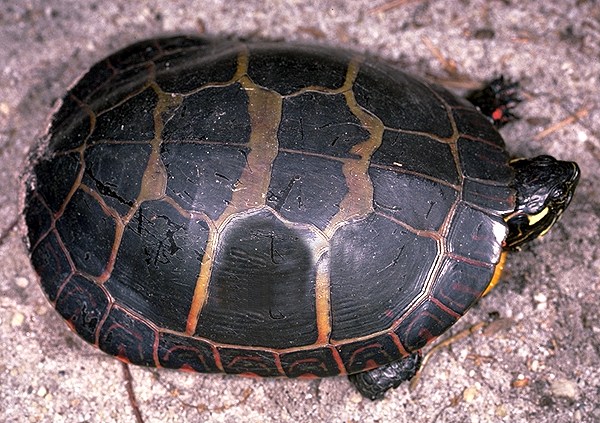
June is turtle nesting season. Unfortunately, this is also the season that turtles are most likely to be crushed on the road. The painted turtle shown here was killed on Winchester Street during summer 2006. Turtles are long-lived organisms that experience high rates of reproductive failure. As a result, relatively modest increases in adult mortality (e.g. from new roads and increased traffic rates) can have significant impacts on population viability. As a result of this and of habitat loss, many Massachusetts freshwater turtles are on the state endangered species list (e.g. Blanding's Turtle, Wood Turtle, Box Turtle, Bog Turtle). In Newton, our primary species are the Painted Turtle and the Snapping Turtle. It is probable that we have Spotted Turtles in at least one location, and it is possible that we have Musk Turtles associated with the Charles. Watch for turtles on the road. If you stop and help a turtle across the road, please be sure that you insure your own safety first!

Sunday, May 20, 2007

Red Squirrels

In urban areas many common species such as the wood frog, ovenbird, or yellow birch, become uncommon to rare. I have often wondered about the status of the red squirrel in Newton. Red squirrels are common in Massachusetts, and tend to favor coniferous or mixed coniferous forests (see Wild Mammals of New England for a good overview). Twice, I have observed road-killed red squirrels on Beacon Street, west of Newton Center (most recently, on 5/7/07). It's a mystery to me where these squirrels were coming from. I have also observed this species at Kennard Conservation Area. Perhaps the red squirrel is more widespread than I think it is? Please report your Newton sightings of this species as a comment to this posting.

Monday, May 14, 2007

The Yellow Warbler

The yellow warbler is one of Newton's Most striking breeding birds. This magnificent bright yellow bird frequents brushy areas, often near water. This bird can be found in urban areas such as the area in front of City Hall and adjacent to Bullough's pond. However, due to its small size, and the fact that it is often concealed in dense vegetation, this bird can be easily overlooked. The yellow warbler is more often heard than seen. If you are a beginning birder, and would like to see the yellow warbler, I suggest that you learn to recognize its song. It is now peak breeding season and males can be heard singing much of the day. The yellow warbler can be seen readily at Bullough's Pond. There is a male singing at the south end of the pond, along the Commonwealth Avenue footpath, immediately east of Walnut Street. Yellow warblers can also be observed at City Hall ponds, Cold Spring Park, Nahanton Park, and many other areas around our City. Although many of our most spectacular songbirds such as the blackburnian warbler and magnolia warbler are migrants, we are fortunate to have the yellow warbler as a summer resident.